
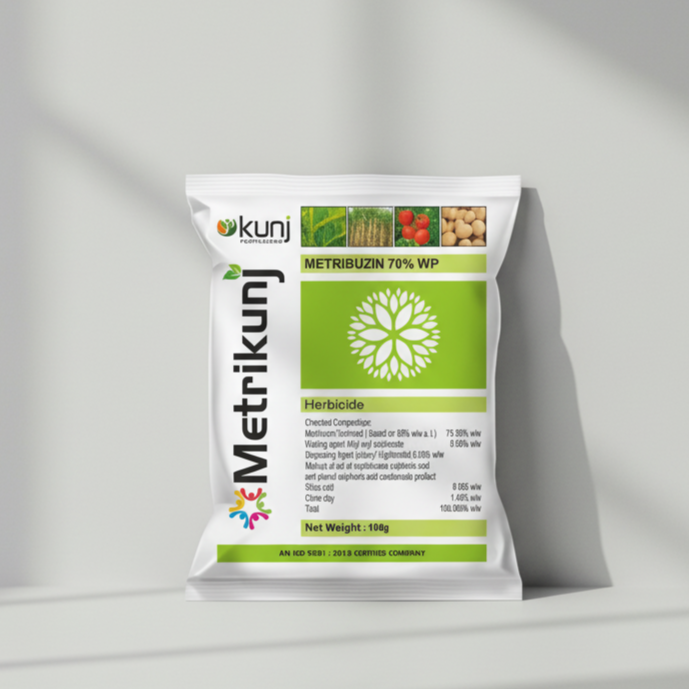
Metrikunj
Metribuzin 70% WP
Available Packing:
500gm, 100gm
Metribuzin 70% WP:
Metribuzin 70% WP is a selective, systemic, and contact herbicide belonging to the Triazinone chemical group, formulated as a Wettable Powder (WP). It is designed to control a wide range of annual grasses and broadleaf weeds in various agricultural crops. It is effective for both pre-emergence and post-emergence application, making it a versatile tool for weed management. It is particularly valued for its ability to control tough weeds like Phalaris minor in wheat which have developed resistance to other herbicides.
Mode of Action:
Metribuzin 70% WP functions by disrupting the photosynthetic process of the weed:
Photosynthesis Inhibition: It works by inhibiting photosynthesis at Photosystem II. This disruption stops the electron transport within the plant cells, effectively cutting off the plant's energy supply.
Systemic Translocation: The active ingredient is absorbed predominantly by the roots, but also through the leaves. Once absorbed, it is translocated via the xylem to other parts of the plant.
Weed Destruction: As the weed's ability to produce food is halted, it stops growing, turns yellow (chlorosis), and eventually dies.
Primary Uses and Target Crops:
This herbicide is used to protect crops from competition with aggressive broadleaf and narrow-leaf weeds.
Key target crops include:
Sugarcane
Potato
Tomato
Wheat
Soybean
Application and Dosage:
Metribuzin 70% WP is mixed with water and applied as a foliar or soil spray.
The recommended dosage varies depending on the crop, soil type, and timing:
Sugarcane:
Pre-emergence: 400 to 600 grams per acre (applied 3-5 days after planting).
Post-emergence: 300 to 400 grams per acre (applied 25-30 days after planting).
Potato:
Pre-emergence: 300 to 400 grams per acre (applied 3-4 days after planting).
Post-emergence: Apply when plants are about 5 cm high.
Wheat:
To control Phalaris minor and broadleaf weeds, use 100 to 120 grams per acre (Medium Soil) or 200 grams per acre (Heavy Soil), applied 30-35 days after sowing.
Tomato:
200 to 300 grams per acre, applied 15 days after transplanting or pre-planting.
Soybean:
200 to 300 grams per acre, applied as pre-emergence (1-2 days after sowing).
General Application: A common water volume is 300 to 400 liters per acre. Ensure the powder is fully dissolved before spraying.
Target Weeds:
This herbicide is effective against a broad spectrum of weeds.
Commonly controlled weeds include:
Grasses: Phalaris minor (Gulli Danda/Canary Grass), Cynodon dactylon (Bermuda Grass), Echinochloa colonum, Digitaria spp.
Broadleaf Weeds: Chenopodium album (Bathua), Parthenium hysterophorus, Trianthema monogyna, Melilotus spp., Fumaria parviflora, Convolvulus arvensis
Sedges: Cyperus rotundus (Motha)
Safety Precautions:
Strict adherence to safety precautions is essential. The product can be toxic if mishandled.
Key safety recommendations include:
Personal Protective Equipment (PPE): Always wear protective clothing, rubber gloves, boots, and a face mask/goggles during mixing and spraying.
Avoid Contact: Avoid inhalation of spray mist and contact with skin and eyes. Wash splashes immediately with soap and water.
Handling Practices: Do not eat, drink, or smoke when using the product. Wash hands and exposed skin thoroughly after use.
Crop Safety: Do not use on crops other than those recommended, as it may cause phytotoxicity (damage) to sensitive plants. Avoid spray drift to adjacent crops.
Environmental Safety: Do not contaminate water sources, ponds, or ditches with the chemical or used containers.
Storage:
Store the product in its original container in a cool, dry, and well-ventilated place, away from direct sunlight, moisture, food, and animal feed. Keep out of reach of children and uninformed persons.