
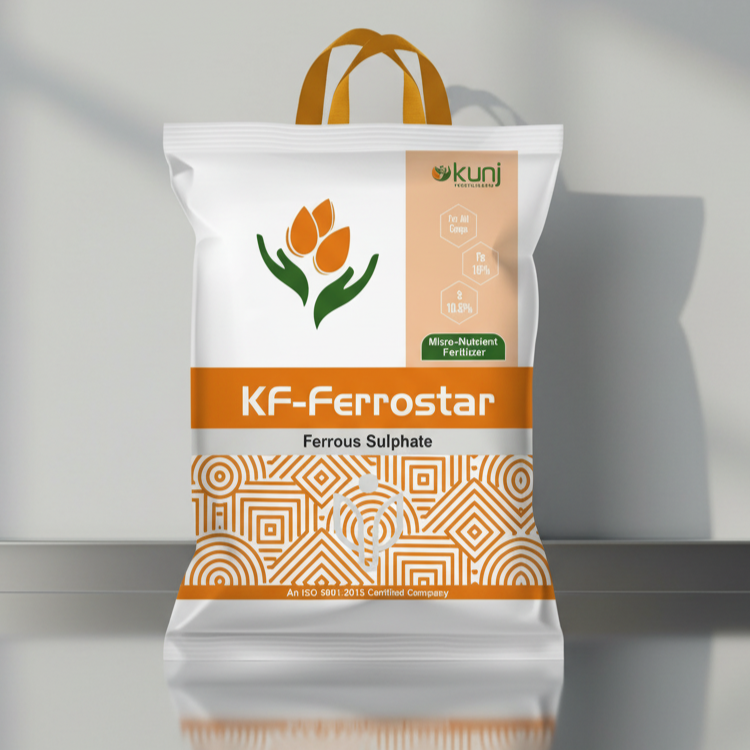
KF-Ferrostar
Ferrous sulphate hepta hydrate
Available Packing:
1kg, 10kg
Ferrous sulphate hepta hydrate:
Ferrous Sulphate Heptahydrate (FeSO₄·7H₂O), also known as Green Vitriol or Copperas, is a widely used and cost-effective source of the essential micronutrient iron (Fe) for plants. It typically comes in the form of blue-green crystals or a granular powder that is highly soluble in water. It is primarily used in agriculture and horticulture to prevent and correct iron deficiency, a condition known as iron chlorosis.
Mode of Action:
As a micronutrient fertilizer, Ferrous Sulphate provides iron in its readily available ferrous (Fe²⁺) form. Iron is a critical component for several vital plant functions, even though it is only required in small quantities.
Chlorophyll Synthesis: Iron is a crucial catalyst in the formation of chlorophyll, the green pigment that enables photosynthesis. Although not part of the chlorophyll molecule itself, its presence is essential for the plant to produce it.
Enzyme Function: It acts as a cofactor for many essential enzymes involved in plant metabolism, including those required for cellular respiration and energy transfer.
Electron Transport: Iron is a component of cytochromes, which are proteins involved in the electron transport chains of both photosynthesis and respiration.
Nitrogen Fixation: It plays an important role in the nitrogen-fixing process in legumes.
When applied, the soluble ferrous sulphate dissolves, allowing the Fe²⁺ ions to be absorbed by the plant's roots or leaves, thereby making the iron available for these critical physiological processes.
Primary Uses and Target Crops:
Ferrous Sulphate is used to treat iron deficiency, which is most common in alkaline and calcareous (high pH) soils where iron becomes locked up in an insoluble form (Fe³⁺) that plants cannot absorb.
Crops that are particularly susceptible to iron deficiency include:
Acid-loving Plants: Azaleas, Rhododendrons, Camellias, Hydrangeas.
Fruit Crops: Grapes, Citrus, Berries (Strawberries, Raspberries), and Peaches.
Field Crops: Sorghum, Groundnut, Soybean, and various legumes.
Vegetables: Tomatoes, Spinach, and Beans.
Turfgrass: It is also commonly used to green up lawns and turf.
Application and Dosage:
Ferrous Sulphate can be applied in several ways, depending on the crop and the urgency of the correction.
Foliar Spray: This provides the quickest results. A general recommendation is to dissolve 2-5 grams per liter of water and spray directly onto the leaves. Adding a sticker or surfactant can improve absorption. Caution is advised, as high concentrations can scorch the leaves.
Soil Application: The product can be applied directly to the soil around the plant base. A typical dosage is 10-25 kg per hectare. However, in high pH soils, the effectiveness can be short-lived as the iron quickly becomes unavailable again.
Fertigation: Due to its high solubility, it can be applied through drip irrigation systems, delivering the nutrient directly to the root zone.
Trunk Injection: For established trees, a direct injection into the trunk can be an effective method.
Symptoms of Iron Deficiency (Iron Chlorosis):
The most classic symptom of iron deficiency is interveinal chlorosis, which appears on the youngest, newest leaves first. This is because iron is immobile within the plant.
The veins of the young leaves remain green while the tissue between the veins turns a pale yellow or even white.
In severe cases, the entire leaf may become bleached, and growth will be stunted.
You may also see necrosis (browning and death) of the leaf margins.
Safety Precautions:
Personal Protective Equipment (PPE): Wear gloves and eye protection during handling to avoid skin and eye irritation. A dust mask is recommended when handling the powder form.
Staining: Be aware that Ferrous Sulphate will cause rust-colored stains on contact with concrete, patios, clothing, and other surfaces. Avoid spreading it on non-target areas.
Handling: Do not eat, drink, or smoke while handling. Wash hands thoroughly with soap and water after use.
Storage:
Store the product in its original, tightly sealed container in a cool, dry place. Keep it away from moisture and direct sunlight, as exposure to air and humidity can cause it to oxidize, turning it into a less effective yellowish-brown ferric sulphate. Keep it out of reach of children and animals.